Discovery Challenges
FLATLAND
Can your algorithm keep trains running on time? We invite researchers and practitioners to tackle one of the hardest challenges in railway operations: dynamic train rescheduling under stochastic perturbations. Built on the open-source environment FLATLAND, this challenge targets the Vehicle Rescheduling Problem (VRSP), i.e. recovering railway traffic across a complex network topology with different types of disruptions. Participants may submit Operations Research (OR) or Multi-Agent Reinforcement Learning (MARL) methods to the two dedicated tracks. This challenge includes multi-stop journeys, time windows for stops, train speed categories, flexible routing, and multiple disruption types including departure delays, breakdowns, and infrastructure failures. Solutions are ranked on a scoring function rewarding punctuality, service compliance, and collision avoidance. Whether you're an OR veteran or an RL enthusiast, join us and help shape the future of resilient railway systems.
Contact Email: competition@flatland-association.org
GreenDIGIT
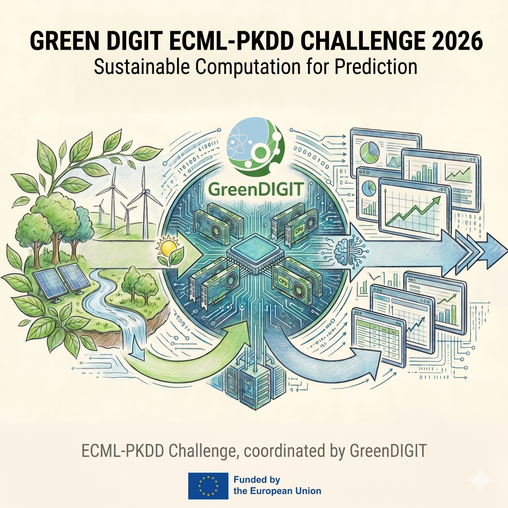
GreenDIGIT addresses the need to reduce the environmental impact of digital research infrastructures (RIs) through data-driven approaches for monitoring, analysing, and improving sustainability performance. As digital infrastructures account for a growing share of global greenhouse gas emissions, the project takes an infrastructure-level view that covers energy consumption, carbon footprint, and other sustainability-relevant dimensions across RI operations. Within this context, the Environmental Impact Metric Publication System (EIMPS) serves as an enabling service for collecting and organising sustainability-related metrics from heterogeneous environments such as Grid, Cloud, and Network infrastructures. This challenge focuses on predictive modelling over operational and sustainability-related time-series data, inviting participants to forecast near-future site-level workload and environmental impact signals - such as jobs, energy consumption, and carbon footprint - in a mature production-like infrastructure setting.
Contact Email: PKDDchallenge@SoBigData.eu
OmniRNA
RNA plays a central role in gene regulation, yet the rules that link RNA sequence, structure, and function remain poorly understood. Foundation models have advanced genomics and protein modelling, but RNA remains harder to model because it folds into complex structures and has fewer standardised annotations. We propose OmniRNA, an ECML/PKDD 2026 Discovery Challenge for reproducible evaluation of AI models for RNA biology. The challenge tests three capabilities: predicting variant effects on RNA fitness, inferring RNA structure from sequence, and identifying evolutionary signals that preserve function. Participants will use shared data splits, baseline methods, and containerised submissions through Codabench. Performance will be assessed on held-out test sets with task-specific metrics and a ranking that rewards balanced performance. OmniRNA will provide a benchmark for RNA modelling and support RNA therapeutics, synthetic biology, variant interpretation, and comparative genomics.
Contact Email: K.Li@exeter.ac.uk